
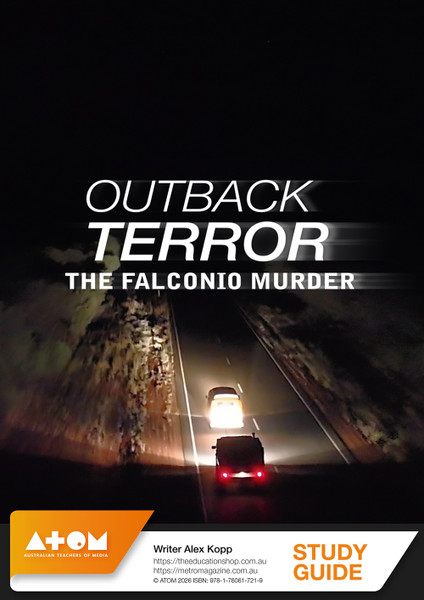

Product Overview
Please note: This study guide contains two versions – a full-colour guide and a text-only version for printing and referencing.
Twenty-five years after the murder of British backpacker Peter Falconio and the attack on his girlfriend Joanne Lees, two world-leading experts examine the famous case like never before. For the first time on television, they use their unique expertise to try to solve the last remaining mystery – where is Peter Falconio?
Geoforensic specialist Dr Mark Harrison MBE and former FBI profiler Kathy Canning-Mello forensically examine the case, using the latest scientific search techniques and advanced criminal behaviour insights. Their mission is to get inside the mind of the murderer and work out where he buried Peter. As they dig deeper into the case, they uncover a flawed investigation and a trial by media of the only surviving victim – Joanne Lees.
Curriculum links:
Outback Terror would be relevant to students in Years 10 and above in the following learning areas:
- English
- The Arts (Media Arts)
- Humanities and Social Sciences
- Psychology
- Legal Studies
- Crime and Justice Studies
General capabilities:
- Personal and Social Capability
- Ethical Understanding
- Critical and Creative Thinking
- Literacy
Key themes:
- Truth and evidence
- Crime and investigation
- Memory and trauma
- Media and public perception
- Forensic science and expertise


